
Registering with the Corporate Affairs Commission (CAC) is how a Nigerian business becomes officially recognised. Whether you are a sole proprietor, a growing company, a professional partnership, or a church, NGO or association, the structure you choose determines your legal identity, your liability, and what you can do next: open a bank account, raise capital, bid for contracts, or receive grants.
This guide walks through the four ways to register a business with the CAC under the Companies and Allied Matters Act (CAMA) 2020: as a business name, a company, a partnership, or an incorporated trustee. It covers what each structure actually means, who it suits, what it costs you in flexibility or protection, and exactly what the CAC requires before it will issue a certificate.
[ VIDEO EMBED — paste your video embed code here ]
What Is CAC Registration in Nigeria?
The Corporate Affairs Commission (CAC) is the federal body responsible for registering and regulating every business entity in Nigeria. CAC Registration is the formal process of placing a business, company, partnership, or organisation on the public register maintained by the Corporate Affairs Commission. Until that filing is approved, the entity has no official legal identity in Nigeria, whatever name it already uses in practice.
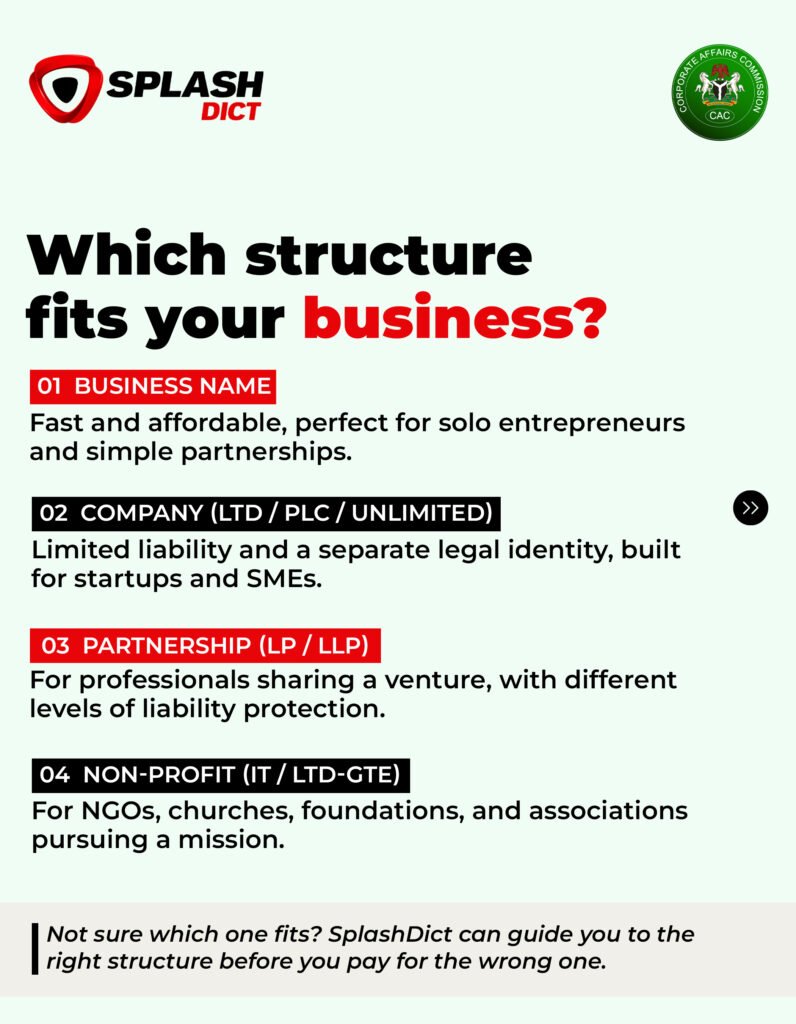
CAMA 2020 recognises several structures. In practice, almost every new registration falls into one of four groups:
- Business Name: for sole proprietors and simple partnerships trading under a name other than the owner's full personal name.
- Company: a separate legal person; typically a private limited company (Ltd), and in some cases a public company (PLC), unlimited company, or company limited by guarantee (LTD/GTE).
- Partnership: a Limited Partnership (LP) or Limited Liability Partnership (LLP), used where partners want a formal partnership vehicle rather than a company.
- Incorporated Trustee: the standard CAC structure for churches, mosques, NGOs, foundations, alumni bodies, and similar non-profit organisations.
These structures are not interchangeable, as a business name does not provide limited liability, a company can issue shares and continue despite changes in ownership, and an Incorporated Trustee cannot be used as a commercial vehicle.
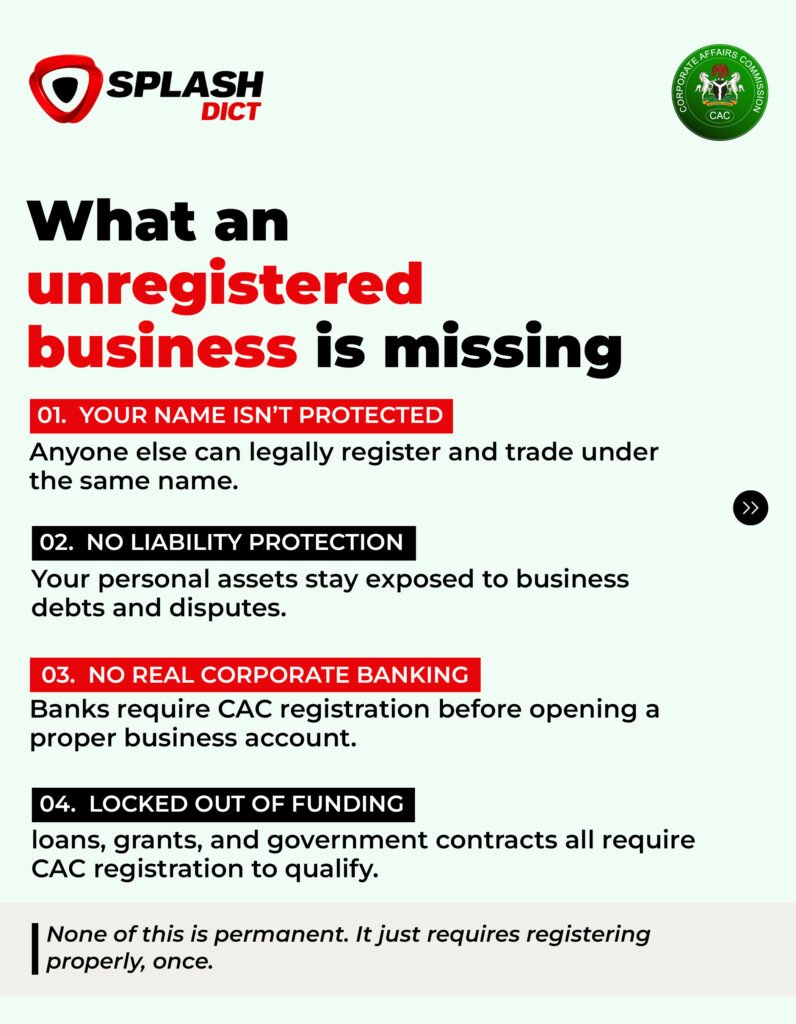
Every one of the four structures creates a different relationship between the owners and the business. A business name gives no separation between the proprietor and the business; the owner is personally liable for its debts. A company creates a distinct legal person, shielding shareholders' personal assets in most circumstances. A partnership sits between the two, depending on whether it is registered as an LP or an LLP. An incorporated trustee cannot distribute profit to its members at all, by design.
Why Register with the CAC?
CAC registration gives a business or organisation a formal place within Nigeria's corporate and business registry. Depending on the entity type and applicable legal requirements, registration can help the entity:
- Establish a recognised legal or registered identity
- Operate under a registered name
- Open and manage business or corporate banking arrangements
- Enter into business and commercial relationships
- Meet customer, regulatory or contractual requirements
- Make the entity easier to verify through official records
- Build confidence with customers, suppliers, investors and business partners
- Create a formal foundation for future growth
The CAC itself identifies registration as a means of giving businesses formal recognition, making them verifiable and supporting access to banking, contracts and other commercial or government services.
Types of CAC Registration in Nigeria
The right choice depends on the nature of your activities, ownership structure, profit objective, liability considerations, and plans.
1. Business Name Registration
A business name is the fastest and most affordable way to formalise a sole proprietorship or a simple partnership. Under Section 814 of CAMA 2020, anyone carrying on business under a name other than their own full personal name is required to register that name with the CAC.
A business name does not create a separate legal person; the proprietor or partners remain personally liable for the debts of the business. It cannot issue shares, and it is generally not the structure investors or federal procurement bodies prefer.
What this registration covers:
- Sole proprietorship: one individual trading under a registered business name.
- Simple partnership: two or more people trading together under a registered business name, without forming an LP or LLP.
| Service Name | Fee | File Now |
|---|---|---|
| Sole Proprietorship Business Name Registration | ₦38,000 | |
| General Partnership Business Name Registration | ₦45,000 |
Ready to register a business name?
2. Company Incorporation
A company is a separate legal entity from the people who own and run it. That is the single most important difference from a business name. The company can own property, enter contracts, sue and be sued, and continue to exist when shareholders change. Liability is generally limited to the unpaid amount on the shares held.
CAMA 2020 allows a private company to be formed by one person. A single founder can now be both the sole director and the sole shareholder. Companies with foreign participation have additional capital and director requirements.
What this registration covers:
- Private company limited by shares (Ltd): the standard vehicle for startups, SMEs, and most commercial businesses.
- Public company limited by shares (PLC): for businesses intending to raise capital from the public.
- Unlimited company: a less common structure where members' liability is not limited.
- Company limited by guarantee (LTD/GTE): a non-profit company structure, often used by professional bodies and organisations that need corporate form rather than Incorporated Trustees. Attorney-General approval is typically required.
| Service Name | Fee | File Now |
|---|---|---|
| One-Person Company Incorporation | ₦50,000 | |
| Unlimited Company Incorporation | ₦60,000 | |
| Private Limited Company (LTD) Incorporation | ₦60,000 | |
| Company Limited by Guarantee (LTD/GTE) Incorporation | ₦80,000 | |
| Public Limited Company (PLC) Incorporation | ₦80,000 | |
| Group Holdings/Consortium Incorporation | ₦100,000 | |
| Foreign-Owned Company Incorporation | ₦2,300,000 |
Ready to incorporate a company?
3. Partnership Registration (LP and LLP)
Not every partnership should be registered as a business name. CAMA 2020 created two dedicated partnership vehicles for professional firms and structured joint ventures: the Limited Partnership (LP) and the Limited Liability Partnership (LLP).
An LLP is a body corporate with separate legal personality and limited liability for its partners. An LP has at least one general partner with unlimited liability and one or more limited partners who do not manage the firm. Both are more formal than a business-name partnership and more flexible than a company for certain professional practices.
What this registration covers:
- Limited Liability Partnership (LLP): a corporate partnership with limited liability and perpetual succession. Minimum of two partners, including designated partners responsible for compliance.
- Limited Partnership (LP): a partnership with mixed liability. Limited partners lose that protection if they take part in management.
| Service Name | Fee | File Now |
|---|---|---|
| Limited Partnership (LP) Registration | ₦40,000 | |
| Limited Liability Partnership (LLP) Registration | ₦45,000 |
4. Incorporated Trustee (Non-Profit) Registration
Churches, mosques, NGOs, foundations, community associations, and alumni bodies are not companies. The standard CAC vehicle for them is Incorporated Trustees under Part F of CAMA 2020. Once registered, the organisation becomes a body corporate that can hold property and enter contracts in its own name, separate from the individual trustees.
Incorporated Trustee registration usually involves newspaper publication and a statutory objection period. A company limited by guarantee is an alternative non-profit structure where a corporate form is specifically required, but it is a different process and typically needs Attorney-General approval.
What this registration covers:
- Incorporated Trustees: the default structure for religious bodies, NGOs, foundations, and associations.
- Company limited by guarantee: a non-profit company used by some professional associations and institutions that need company form rather than trustees.
| Service Name | Fee | File Now |
|---|---|---|
| NGO / Incorporated Trustee Registration | ₦60,000 | |
| Company Limited by Guarantee (LTD/GTE) Incorporation | ₦80,000 |
Registering an NGO, church, or association?
How to Register with CAC: The Step-by-Step Process
Regardless of which registration type you choose, the general process is similar. Here's how it works:
- Choose the correct structure: Business name, company, LP/LLP, or Incorporated Trustee. This decision drives every document that follows.
- Search and reserve the name: Confirm availability and obtain reservation or RG's Consent before filing the full application.
- Prepare the supporting documents: Identification, address evidence, MEMART or constitution or partnership agreement, and particulars of the people behind the entity.
- Disclose control where required: Companies and LLPs must record Persons with Significant Control at registration.
- File through the official CAC portal: Applications are processed online.
- Collect the documents: Once approved, download the digital certificate, status report, MEMART/Constitution/Partnership Deed, and Stamp Duty certificate and keep them with your statutory records.
How SplashDict Helps with CAC Registration in Nigeria
At SplashDict, we help entrepreneurs, businesses and organisations identify the right CAC entity structure, understand the registration requirements, prepare the required information and complete the application through the appropriate CAC process.
As a CAC-accredited filing platform staffed by ICSAN-licensed chartered secretaries, we handle the end-to-end registration of business names, companies, LPs, LLPs, and Incorporated Trustees through our platform.
Once your entity is registered, we deliver your CAC certificate, Status Report, MEMART, Constitution, Partnership Deed, Stamp Duty Certificate, and other applicable incorporation documents.
Start Your CAC Registration Now →
SplashDict Limited is a corporate secretarial and business support services firm registered in Nigeria. It is not a law firm and does not provide legal advice. Statutory references in this article reflect general provisions of CAMA 2020 and current CAC practice; always confirm the specific requirements applicable to your filing.