
Every registered entity in Nigeria, whether a company, business name, incorporated trustee, or partnership, carries a fixed set of core details on file with the Corporate Affairs Commission: its legal name, its registered address, the activities it is licensed to carry out, its governing documents, and its share capital or ownership structure.
Businesses change; a company rebrands, an office relocates, a trading company starts offering financial services it was never registered for, a partnership rewrites its agreement, and shares get allotted, transferred, or used as security for a loan. None of that reflects on CAC’s register until you file CAC entity changes formally, and the gap between what your business actually is today and what CAC has on record is where banking, licensing, and due diligence problems start.
This guide covers what counts as a CAC entity change, why filing it is not optional, the one hard statutory deadline you cannot afford to miss, and how each category actually gets filed.
What Does It Mean to File CAC Entity Changes?
CAC entity changes are the filings used to update an entity’s core corporate records with the Corporate Affairs Commission. An entity change alters one of those core details rather than who leads or owns the business. In practice, this covers:
- A registered name change, happening after a rebrand, a correction, or a restructuring
- A registered address change, happening after an office move or a shift in the principal place of business
- A business activity change, happening when the entity starts operating outside its originally registered objects
- A governing document change, updating a company’s memorandum and articles, an incorporated trustee’s constitution, or a partnership agreement
- A capital or shares change, covering allotments, transfers, capital increases or reductions, and charges registered over company assets
- A formal cessation, striking off, dissolution, or liquidation, happening when an entity stops operating altogether
The same events apply across companies, business names, limited partnerships, limited liability partnerships, and incorporated trustees. The filing type, documents, and timeline change with the entity and CAC must hold the current version of the record.
Why Keeping Your CAC Corporate Records Updated Matters
CAC’s register is the single public source of truth for a Nigerian entity’s identity. Banks check it before opening or maintaining an account, investors and acquirers check it during due diligence, and regulators and licensing bodies cross-reference it against the activities a business actually carries out.
When your legal name, address, objects, or capital structure on file no longer match reality, that reliance breaks down, and it shows up as blocked transactions, security that turns out to be unenforceable, and licence or contract applications that stall because what you presented does not match what CAC has.
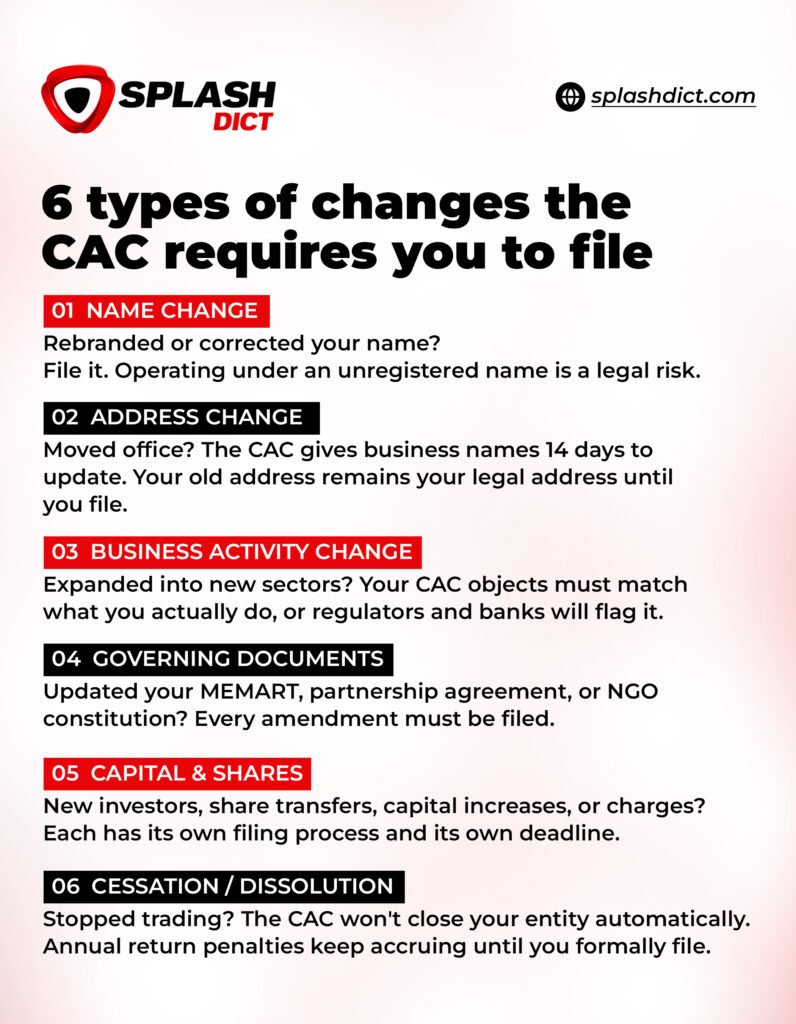
Types of CAC Entity Changes and Corporate Record Updates
The Corporate Affairs Commission categorizes entity changes and corporate record updates into distinct filing types, each with its own triggers, specific document requirements, and strict statutory deadlines.
At SplashDict, our post-incorporation services cover every recognized filing category required to keep your business fully compliant. People changes are covered separately in the leadership, ownership and governance guide.
1. Change in CAC Registered Name
A registered name is part of an entity’s legal identity, and operating under a name that no longer matches the CAC record, however long you have used it in practice, creates real legal and contractual risk.
The process begins with a name availability search and reservation on the CAC Integrated Company Registration Portal (iCRP). Under the modern automated system, standard name reservations for regular Companies, Business Names, and Partnerships are processed instantly once payment is confirmed.
However, if you are rebranding a Company Limited by Guarantee (LTD/GTE) or an Incorporated Trustee (NGO, Church, or Association), name approval is not instant. These entities are legally required to go through the Name Requiring Consent route to obtain specialized, manual approval from the Registrar-General before the name can be locked down.
For companies, a special resolution must then be passed before the final change can be submitted. Once approved, a new certificate bearing the new name is issued, and your original certificate must be surrendered to the CAC.
Typical Trigger: A corporate rebrand, a correction to a misspelled or duplicated name, or a structural reorganization that requires a completely new identity.
What people mix up: Updating a logo or domain is not a name change. Converting a business name into a company also isn’t a name change, because conversion is a different process and creates a new entity type.
| Service Name | Fee | File Now |
|---|---|---|
| Change of Name of Registered Business Name | ₦35,000 | |
| Registration of Change in Name of LLP | ₦35,000 | |
| Change of Name of Company | ₦20,000 | |
| Registration of Change in Name of LP | ₦35,000 | |
| Change of Name of Incorporated Trustees | ₦50,000 |
Rebranding or correcting your registered name?
2. Change in CAC Registered Address
Your registered address is the official location on record with the CAC, the address to which legal notices, regulatory correspondence, and service of process are directed. Updating your letterhead or website is not enough, and until you formally file the change, your old address remains your official legal address, regardless of your actual location.
Typical trigger: an office move, a change of principal place of business, or relocating to a different state.
What people mix up: A branch, warehouse, or correspondence address is not automatically the registered address. Only the address recorded with CAC is the registered one, and a P.O. Box is not accepted as a registered office.
| Service Name | Fee | File Now |
|---|---|---|
| Change of Company Registered Address | ₦30,000 | |
| Change of Registered Address of LLP | ₦30,000 | |
| Change of Address of Business Name | ₦25,000 | |
| Registration of Change in Principal Place of Business of LP | ₦25,000 | |
| Change of Registered Address of Incorporated Trustees | ₦30,000 |
Moved office or changed your business address?
3. Change in CAC Business Activity (Objectives)
The objects or nature of business on the CAC file is the legal description of what the entity is allowed to do. If the company, business name, partnership, or trustee body starts doing work outside that description, the record has to be widened before the new work is treated as authorised on the public register.
For a company, a change of objects is usually an alteration of the memorandum. That needs a special resolution and a MEMART filing. For a business name or partnership, it is a change of objects or principal business activity. For an incorporated trustee, changing objects is normally tied to an amendment of the constitution and may require public notice.
Typical trigger: A new product line, a shift into a regulated activity, a donor or bank asking for objects that match the work now being done, or a correction of objects that were too narrow at registration.
What people mix up: Adding a new activity is not always a full constitution rewrite. If only the objects need widening, use the objects or activity filing. If the internal rules also change, that is a governing document filing and may run beside this one.
Operating outside your registered business activities?
4. Change in CAC Governing Documents
Governing documents are the rules the entity lives by. For a company, that is the memorandum and articles of association. For an incorporated trustee, it is the constitution. For an LP or LLP, it is the partnership agreement.
These filings are used when the rules themselves change, including voting rights, appointment powers, meeting procedures, winding-up clauses, or the objects clause where that sits inside the same document. A company MEMART alteration needs a special resolution and filing with CAC.
An incorporated trustee constitution amendment is heavier, and it commonly needs a valid meeting, an updated constitution, and newspaper publication. A partnership agreement change must match what CAC has on the partnership file.
Typical trigger: A restructuring, a new investor asking for different articles, a church or NGO revising its constitution, or a partnership rewriting contribution and management rules.
Statutory deadline: File the altered document within the period allowed after the resolution or meeting. For company special resolutions, that is commonly 15 days.
What people mix up: Changing a director or trustee is not a governing document change. Those people filings belong on the leadership and ownership page. Use this category only when the document that governs the entity is what changed.
Updating your MEMART, constitution, or partnership agreement?
5. Changes in CAC Capital and Shares
A company’s shareholding structure and capital base are among its most fundamental legal attributes. Bringing in a new investor, restructuring equity among existing shareholders, registering a charge over company assets, or handling the transmission of shares after a shareholder’s death all require formal CAC filings, each with its own process and, for one category, a hard statutory deadline.
Typical trigger: A new investment, a bonus or rights issue, a buy-back or reduction, a sale of shares, death of a shareholder, or a bank taking security over company assets.
Statutory deadline: A return of allotment is commonly due within 15 days. A charge should be registered within 90 days of its creation. Transfers and transmissions should be filed as soon as the instrument and approvals are in place.
What people mix up: Increasing authorised or issued capital is not the same as transferring shares already in issue. One creates or records new capital, while the other moves existing shares. A share transfer that pushes a buyer to 5 percent or more is also not complete until the PSC file is updated.
| Service Name | Fee | File Now |
|---|---|---|
| Transmission of Shares | ₦30,000 | |
| Transfer of Shares | ₦30,000 | |
| Reduction in Issued Share Capital | ₦30,000 | |
| Transmission, Transfer, Surrender & New Allotment of Shares | ₦30,000 | |
| Increase in Issued Share Capital & Share Allotment | ₦30,000 | |
| Statement of Satisfaction in whole or in part of a charge | ₦30,000 |
Restructuring shares or registering a charge?
6. CAC Cessation / Striking Off / Dissolution / Liquidation
This is the filing family used when the entity should no longer exist on the live register. A business name files cessation. A company may be struck off, dissolved, or put through a formal winding up. An incorporated trustee is dissolved. An LP files notice of cessation. Until one of those processes is accepted, the entity remains live, and annual returns can keep accruing.
Cessation of a business name is the lightest close-out. Striking off a dormant company is different from a full liquidation. Dissolution of an incorporated trustee can require publication and a clean record of trustees and assets. Liquidation is an insolvency process and should not be treated as a simple portal form.
Typical trigger: The business has stopped trading, the founders want the name off the register, a dormant company must be removed, or an association is winding up.
Usual timing: no fixed filing deadline applies, but the longer an unfiled cessation sits, the more annual return penalties accumulate against it in the meantime.
What people mix up: Stopping operations is not cessation, and leaving the certificate in a drawer is not striking off. If the entity is still on the register, it is still a registered entity. Converting a business name into a company is also not cessation of the old name unless that close-out is filed as its own step.
| Service Name | Fee | File Now |
|---|---|---|
| Voluntary Stiking Off of Company | ₦20,000 | |
| Filling Notice of cessation of an LP | ₦70,000 | |
| Cessation of Business Name | ₦25,000 | |
| Dissolution of Incorporated Trustees | ₦25,000 |
Stopped trading but never formally closed?
CAC Filing Deadlines and Document Requirements for Entity Changes and Corporate Records
Entity changes do not all follow the same CAC process. Changing a company name is different from changing a business-name address. Amending objects is different from rewriting a constitution. Increasing share capital is different from transferring existing shares. The table below summarises the main filing categories, their usual statutory timelines, typical processing time, and the documents and rules that should be considered before submission.
The table breaks every CAC entity change down individually: what the filing is for, when it is due, how long it usually takes, and what to have ready before you start.
| Filing Service Category | Statutory Deadline | Typical Processing Time | Key Documentation and Critical Rules Required for Filing |
|---|---|---|---|
| 1. Change of Company Name Used when filing notice of change of name for a limited liability company or a company limited by guarantee. |
After name reservation and special resolution, file without delay | 1 to 5 working days |
|
| 2. Change of Name of Incorporated Trustees Used when filing notice of a name change for an NGO, church, or association. |
Subject to the applicable publication and objection process | 1 to 14 days after the statutory wait time, if applicable |
|
| 3. Change of Name of Registered Business Name Used when filing notice of a name change for a sole proprietorship or partnership. |
File promptly after the change | Almost instant or same day |
|
| 4. Change in Name of LLP Used when registering a name change for a limited liability partnership. |
Within 30 days | 1 to 5 working days |
|
| 5. Change in Name of LP Used when registering a name change for a limited partnership. |
Within 7 days | 1 to 5 working days |
|
| 6. Change of Address of Business Name Used when filing a notice of change in principal place of business or branch address. |
File promptly after the change | Almost instant or same day |
|
| 7. Change of Company Registered Address Used when filing a notice of change in registered and or head office address. |
Within 14 days | 1 to 5 working days |
|
| 8. Change of Registered Address of Incorporated Trustees Used when updating the registered address of an NGO, church, or civic body. |
Within the applicable statutory period | 1 to 14 days after the statutory wait time, if applicable |
|
| 9. Change of Registered Address of LLP Used when updating the registered address of a limited liability partnership. |
Within 30 days | 1 to 5 working days |
|
| 10. Change in Principal Place of Business of LP Used when updating the principal place of business of a limited partnership. |
Within 7 days | 1 to 5 working days |
|
| 11. Alteration of MEMART for Objects Used when amending the memorandum and articles so a company can operate outside its current objects. |
Within 15 days of the special resolution | 1 to 5 working days |
|
| 12. Amendment of Constitution and Change of Objects of Incorporated Trustees Used when amending the registered objects of an NGO, church, or civic body. |
Subject to the applicable publication and objection process | 1 to 14 days after the statutory wait time, if applicable |
|
| 13. Change of Objects for Business Name Used when updating the registered business activities of a sole proprietorship or partnership. |
File promptly after the change | Almost instant or same day |
|
| 14. Change of Principal Business Activity of LLP Used when updating the principal activity of a limited liability partnership. |
Within 30 days | 1 to 5 working days |
|
| 15. Change in General Nature of Business of LP Used when updating the general nature of business of a limited partnership. |
Within 7 days | 1 to 5 working days |
|
| 16. Alteration of MEMART Beyond the Objects Clause Used when amending the memorandum and articles for internal rules, and not only the objects clause. |
Within 15 days of the special resolution | 1 to 5 working days |
|
| 17. Amendment of Constitution of Incorporated Trustees Used when amending the internal rules of an NGO, church, or civic body, not only the objects. |
Subject to the applicable publication and objection process | 1 to 14 days after the statutory wait time, if applicable |
|
| 18. Change of Partnership Agreement of LLP Used when registering a change in the partnership agreement of a limited liability partnership. |
Within 30 days | 1 to 5 working days |
|
| 19. Change of Partnership Agreement of LP Used when registering a change in the partnership agreement of a limited partnership. |
Within 7 days | 1 to 5 working days |
|
| 20. Increase in Issued Share Capital and Share Allotment Used when filing an increase in authorised and issued share capital alongside the allotment. |
Within 15 days of the allotment | 1 to 5 working days |
|
| 21. Reduction in Issued Share Capital Used when filing a formal reduction in a company’s issued share capital. |
Subject to the applicable court or CAMA reduction process | 1 to 5 working days after the statutory process, if applicable |
|
| 22. Transfer of Shares Used when registering the transfer of shares from one shareholder to another. |
Within the applicable statutory period after the transfer | 1 to 5 working days |
|
| 23. Transmission of Shares Used when filing the legal transmission of shares due to death, bankruptcy, or operation of law. |
Within the applicable statutory period after the triggering event | 1 to 5 working days |
|
| 24. Statement of Satisfaction of a Charge Used when confirming that a previously registered charge has been paid off or satisfied. |
File promptly after the charge is paid off or satisfied | 1 to 5 working days |
|
| 25. Transmission, Transfer, Surrender and New Allotment of Shares Used for a combined filing covering multiple share movements in one transaction. |
Within 15 days of the allotment, and within the applicable period for any transfer or transmission in the same set | 1 to 5 working days |
|
| 26. Cessation of Business Name Used when filing a formal notice of cessation of a registered business name. |
File promptly when the name is no longer in use | Almost instant or same day |
|
| 27. Dissolution of Incorporated Trustees Used when formally dissolving a registered NGO, church, or civic body. |
Subject to the applicable publication and CAC dissolution process | 1 to 14 days after the statutory wait time, if applicable |
|
| 28. Cessation of Limited Partnership Used when filing notice of cessation of a limited partnership. |
Within 7 days | 1 to 5 working days |
|
| 29. Voluntary Striking-off Used when applying to remove a dormant or unused company from the live register. |
File once the company is eligible and the required notices are ready | 1 to 5 working days after the statutory notice period, if applicable |
|
| 30. Liquidation or Winding Up Used when placing a company into a formal winding-up or liquidation process. |
Within the applicable statutory period for the appointment or petition | Subject to the court or insolvency process |
|
Important CAC Filing Rules
A name change, address change, objects change, constitution change, capital change, and close-out filing are different services. Use the row that matches what actually changed.
For companies, a special resolution is commonly needed for a name change and for a MEMART alteration. For a company limited by guarantee, and for an incorporated trustee, the proposed name is a special name requiring consent. Obtain that consent during name reservation before the change of name is filed.
For incorporated trustees, a name, objects, constitution, or dissolution filing may also require newspaper publication and a waiting period before CAC will complete the file.
For share capital, an increase and allotment is not the same filing as a transfer of existing shares. If the transfer or allotment also changes who controls 5 percent or more of the company, file the related PSC update as well.
These requirements provide a practical guide to the documents and timelines commonly associated with CAC entity changes and corporate record filings. The exact documents required can vary depending on the entity type, the nature of the change, and the circumstances surrounding the filing.
Where a change involves multiple records, such as a share allotment that also changes the persons with significant control, the related CAC filings should be completed together so that the public record remains consistent.
How to File CAC Entity Changes and Update Corporate Records on the CAC iCRP Portal
Here is the exact step-by-step process required to file these entity changes and corporate record updates:
- Step 1: Check Your Annual Returns Status: Before the portal allows you to initiate any entity change, your entity must be in good standing. If your company has outstanding Annual Returns, the portal will completely lock you out of post-incorporation filings. You must calculate, pay, and clear all backdated annual returns first.
- Step 2: Access the Post-Incorporation Account: Log into the portal using an accredited agent’s credentials. Once inside, look up the target entity using its RC Number, BN Number, IT Number, LP Number, or LLP Number. Click on “Filing” and select the exact service category that matches your change (e.g., Change of Name, Change of Address, Change of Objects, Allotment, or Cessation).
- Step 3: Update the System Information: Input the new data directly into the portal fields. For a name change, enter the reserved name exactly as approved. For an address change, enter the new physical address in Nigeria. For objects, capital, or close-out filings, enter the details exactly as they appear on the supporting resolution or instrument. Any mismatch between the portal fields and the uploaded documents will stall the application.
- Step 4: Generate and Pay the Filing Fees: The portal will calculate the statutory filing fee based on your selection. Payments are processed via Remita. Keep in mind that if you are filing outside the statutory window (e.g., more than 15 days after an allotment, or more than 90 days after creating a charge), the portal may compute and add cumulative late-filing penalty fees to your total.
- Step 5: Prepare and Upload the Supporting Documents: Print out the system-generated forms, have them signed by the authorized officers, and scan them back into the portal alongside your supporting documents. These include special resolutions, altered MEMART or constitution pages, proof of the new address, stamp duty evidence for capital increases, charge instruments, publication copies for incorporated trustees, and the old certificate where CAC still asks for it. Files must be clear, legible, and under the portal’s strict PDF size limits.
- Step 6: Submit for Review and Monitor for Approval: Once submitted, the filing moves into the “Pending Approval” queue. A CAC registry officer will review the documentation. If anything is wrong, such as an illegible signature, a missing name-consent approval, or a wrong filing type, the application will be queried. If everything is flawless, it is marked as approved.
- Step 7: Download the Updated Status Report: Once approved, you can download the fresh CAC Status Report or updated certificate directly from the portal. This document serves as your official legal proof for future banking, compliance, and regulatory checks.
Why CAC Entity Changes Filings Get Rejected (The Query List)
The Corporate Affairs Commission has become incredibly strict with post-incorporation updates. If a registry officer notices even a minor mismatch between your uploaded documents and the information entered on the portal, they will issue an official “Query”.
The most common reasons CAC entity change filings get rejected include:
- Filing Under the Wrong Service Category: This is the most common portal mistake. For instance, selecting a MEMART alteration when only the registered address changed, or selecting cessation when the real need is a name change. The CAC will query this immediately.
- Name Not Reserved or Name Requiring Consent Missing: A new name that was never reserved, or a Company Limited by Guarantee or Incorporated Trustee name filed without the required Name Requiring Consent approval, will be rejected.
- Objects That Do Not Match the Resolution: The portal text describes activities the special resolution or constitution never approved.
- Unpaid or Legacy Annual Returns: You cannot build a new room on a broken foundation. If your entity has outstanding or un-updated Annual Returns from previous years, the CAC will reject any new name, address, objects, capital, or close-out filing until those backdated compliance debts are completely cleared.
- Defective Resolutions and Missing Signatures: The board or member resolutions uploaded must be perfectly clear, written on the company’s official letterhead, and signed by authorized officers (usually a director and the company secretary). If a signature is illegible, cropped out, or missing entirely, the filing fails.
- Missing Publication for Incorporated Trustees: For NGOs, churches, and mosques, a name, objects, constitution, or dissolution filing may require newspaper publication and a waiting period. Uploading only minutes is not enough.
- Mismatched Equity Allotments: For capital updates, the number of new shares being allotted must align perfectly with your company’s Unissued Share Capital. If you try to allot more shares than the company currently has available, the system will flag it as an error.
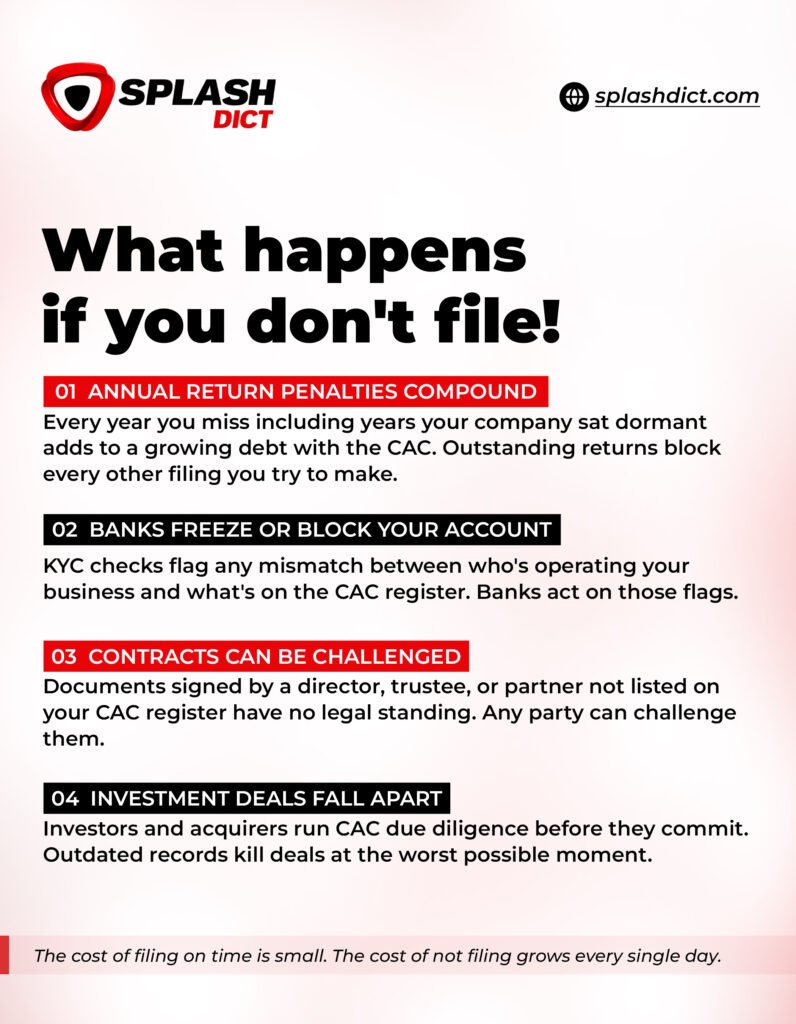
Penalties and Risks of Not Updating CAC Records in Nigeria
“We’ll get to it eventually” is the most expensive sentence in Nigerian corporate compliance. Here is what actually happens when entity changes and corporate records go unfiled.
Broken KYC and banking files: Banks match the name and address on your account to the CAC register. A rebrand or office move that was never filed looks like a different business, and the bank can flag or restrict the account until the record is corrected.
Contracts and invoices in the wrong name: After a rebrand, counterparties will still treat the old registered name as the legal person until CAC issues the new record.
Licences that do not match objects: A business operating outside its registered objects can lose a licence application or a tender on a records check.
Charges and investments that are not on the register: An unregistered charge can lose priority. An unfiled allotment leaves the investor off the public file.
Returns that continue after the business has stopped: Until cessation, striking off, or dissolution is accepted, the entity can keep accumulating annual return obligations and late penalties.
How SplashDict Files Your CAC Entity Changes and Corporate Records
Need to update your CAC records? SplashDict can process the appropriate post-incorporation filing for your business, including changes involving registered name, address, business activities, governing documents, share capital, charges, and formal close-out. We handle the required documentation, CAC submission, and follow-up through to completion, giving you a straightforward way to keep your registered records up to date.
Update Your CAC Entity Records Now

SplashDict Limited is a corporate secretarial and business support services firm registered in Nigeria. It is not a law firm and does not provide legal advice. For complex legal or tax matters, please engage a qualified legal practitioner or chartered accountant. Statutory references in this article reflect general provisions of CAMA 2020; always confirm the specific requirements applicable to your filing.