
Every registered business in Nigeria, whether it’s a limited company, a business name, an NGO registered as an incorporated trustee, or a partnership, has a fixed set of facts sitting on file with the Corporate Affairs Commission: who owns it, who runs it, and who’s allowed to sign on its behalf.
Those facts change constantly in the real world. A director resigns, a shareholder sells their stake, or a new chairman takes over an association. None of that is official, legally, until it’s filed with CAC. And the gap between what actually happened and what CAC has on record is where businesses can run into trouble: frozen accounts, rejected filings, deals that fall apart during due diligence.
This guide covers what counts as a leadership, ownership, or governance change, why the law treats it as non-negotiable, the statutory deadlines under the Companies and Allied Matters Act (CAMA) 2020, and how to get these changes filed the first time correctly.
What are CAC Leadership, Ownership and Governance Record Changes in Nigeria?
Broadly, CAC Leadership, Ownership, and Governance Changes refer to the mandatory statutory filings a business or organization in Nigeria must submit to the Corporate Affairs Commission (CAC) whenever there is a shift in its internal management, structure, or control.
Under the Companies and Allied Matters Act (CAMA), the CAC serves as Nigeria’s official company registry. The commission must be formally notified within strict statutory deadlines whenever these changes occur to ensure the public record remains accurate and legally compliant.
In practice, it covers:
- Director Updates: A company appointing, removing, or changing a director’s recorded details (name, address, nationality).
- Proprietor and Partner Changes: A registered Business Name changing its proprietors, partners, or their personal details.
- Incorporated Trustee Adjustments: An NGO, church, mosque, or association appointing, replacing, or updating a trustee, chairman, or secretary.
- Shareholder and Member Shifts: A company recording changes to its shareholders, guarantors, or members (e.g., share transfers or allotments).
- Company Secretary Transitions: A company or incorporated trustee appointing or replacing its statutory secretary.
- PSC Disclosures: A change in the ultimate beneficial ownership, known as a Person with Significant Control (PSC).
- Insolvency and Restructuring: A business entering administration or receivership with a formally appointed receiver.
Each of these starts as something internal: a board resolution, a share sale agreement, a resignation letter, sometimes a court order. It only becomes a matter of public record once it’s filed with CAC.
Why You Must Update CAC Records After a Leadership or Ownership Change
The Corporate Affairs Commission (CAC) keeps the official public register for every company, business name, partnership and Incorporated trustee in Nigeria. Banks, investors, government agencies, and partners rely entirely on this register for KYC checks and business verification.
Here is what it will actually cost you if you do not update your records:
- Heavy Late-Filing Fines: The CAC gives very strict deadlines to report changes. For example, you must file director updates within 14 days, and PSC changes within one month. Missing these windows triggers daily penalty fees that accumulate rapidly. The CAC will block all your future applications until these fines are fully paid.
- Frozen Bank Accounts and Blocked Loans: Nigerian banks verify company details directly through the CAC portal. If you change your directors or partners internally but fail to notify the CAC, banks will freeze your corporate account modifications, block loan approvals, and halt major transfers due to the profile mismatch.
- Failed Tenders, Contracts, and Funding: Serious investors, venture capitalists, and government procurement boards perform strict due diligence. If the names on your contract do not match the names on your official CAC Status Report, your business looks unorganized and non-compliant, which will get you disqualified immediately.
- Personal Liability and Fraud Risks: Keeping your records updated protects everyone. If a retired director’s name is not formally removed from the portal, they can still be held personally liable for the company’s debts or legal troubles. On the flip side, new appointees cannot legally sign binding contracts for the company until they are registered.
- A Blocked CAC Portal: The CAC portal works step-by-step. If you want to do something else later, like increase your share capital or change your business description, the system will completely block your application if your past leadership or ownership records are outdated.
In Nigeria, an internal change only becomes legally valid once the CAC stamps it. Keeping your records up to date moves your business from a compliance risk to a trusted brand.
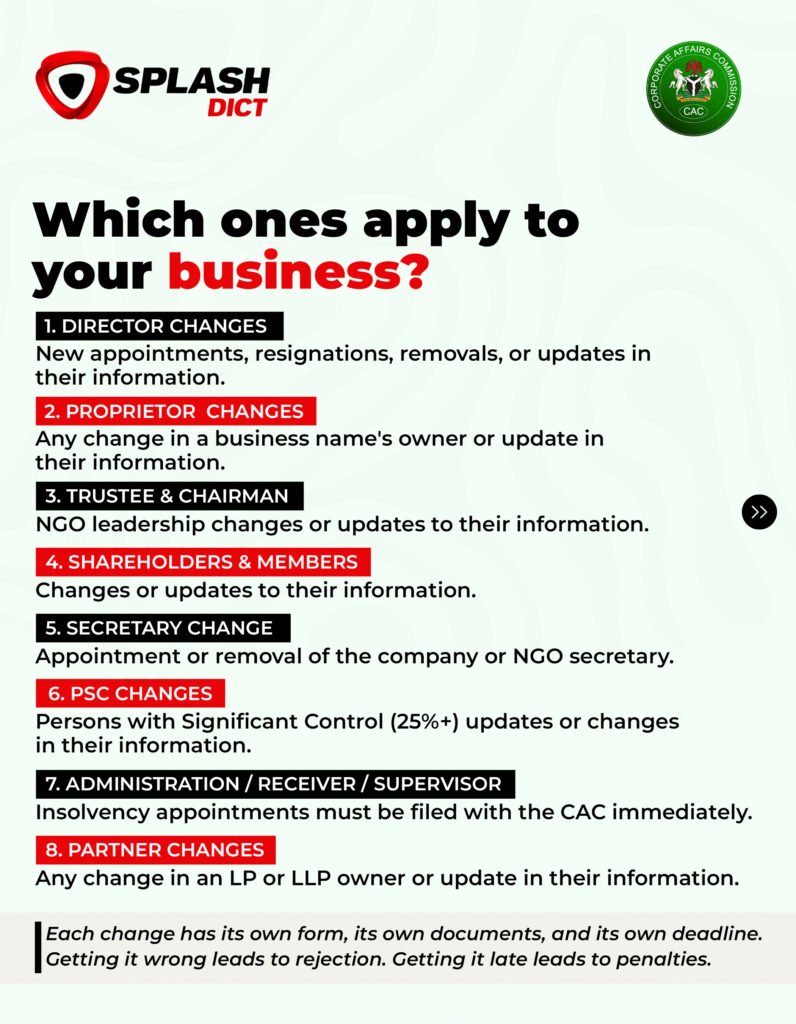
Types of CAC Leadership, Ownership and Governance Changes
The Corporate Affairs Commission categorizes management and ownership changes into distinct filing types, each with its own triggers, specific document requirements, and strict statutory deadlines.
At SplashDict, our post-incorporation services cover every recognized filing category required to keep your business fully compliant.
1. Director Changes
Directors are the people legally responsible for managing a company on behalf of its Members. A private company must have at least one director; companies that are not “small companies” under CAMA 2020 must have at least two.
Any appointment, resignation, removal, retirement, death, or correction of a director’s particulars (name, address, nationality, identification) must be notified to the CAC.
Typical trigger: Board or members’ resolution, letter of resignation, or a change in the director’s personal details.
Usual deadline: Notify the Commission within 14 days of the change.
What people mix up: Changing a director and only correcting a director’s address or ID are different filings. Use “change of director” when the person on the board changes. Use “change in particulars” when the same person stays on the board but their recorded details are wrong or outdated.
| Service Name | Fee | File Now |
|---|---|---|
| Change of Director | ₦30,000 | |
| Change in Particulars of Director | ₦30,000 |
Need to update your company’s directors?
2. Proprietor and Partner Changes (Business Names)
A registered business name is legally tied to its proprietors, the individuals or entities who own and operate the business.
Adding a partner, removing one, selling the business, or correcting a proprietor’s name, address or identification all have to be reflected on the register. Until that happens, the person who appears on the certificate is still the person banks and agencies will treat as the owner.
Typical trigger: Sale of the business, admission or retirement of a partner, or a correction of existing particulars.
Statutory Deadline: You must notify the CAC within 14 days of the change occurring.
What people mix up: A business-name proprietor change is not the same as converting the business name into a company. Conversion is a different process. If you are only changing who owns the existing business name, stay in this category.
| Service Name | Fee | File Now |
|---|---|---|
| Change of Proprietor/Partner(s) | ₦25,000 | |
| Correction of Proprietor/Partner(s) Information | ₦25,000 |
Need to update the proprietor of a registered business name?
3. Partnership Changes (LP and LLP)
A Limited Partnership (LP) or Limited Liability Partnership (LLP) is governed by its partnership agreement, and CAC’s record of who the partners are, what they’ve contributed, and whether they hold general or limited liability has to match that agreement. Adding or removing a partner, correcting a partner’s recorded details, or changing a partner’s liability status or capital contribution are each their own filing, not variations of the same one.
Typical trigger: Admission or retirement of a partner, a partner converting between general and limited liability, a change in a partner’s capital contribution, or a correction to a partner’s recorded details.
Statutory Deadline: You must notify the CAC within 14 days of making any change to the partners, their particulars, or their financial stakes.
What people mix up: A change in a partner’s liability status is not the same filing as a change in their contribution amount, even when both happen together.
| Service Name | Fee | File Now |
|---|---|---|
| Change of Partner’s Particulars in Limited Partnership (LP) | ₦25,000 | |
| Change in Partner(s) of LP | ₦25,000 | |
| Registration of Change in Partner Contribution of LP | ₦25,000 | |
| Registration of Change in Liability of Partner of LP | ₦25,000 | |
| Change of Partner’s Particulars in LLP | ₦30,000 | |
| Change in Partner(s) of LLP | ₦30,000 | |
| Registration of Change in Partner Contribution of LLP | ₦30,000 |
Need to update your LP or LLP partnership records?
3. Trustee and Chairman Changes (Incorporated Trustees)
NGOs, churches, mosques, professional bodies and associations registered as incorporated trustees are governed by a board of trustees and led by a chairman. Because these organisations often hold donor funds or public contributions, the Commission watches who has legal authority to act.
A change of trustee is slower than a company director change for a reason. In many cases a public notice must be published and a period allowed for objections before the Commission will process the replacement. Particulars updates (a trustee’s new address or ID) are lighter. Appointing or replacing the chairman or the secretary of the trustees is its own filing.
Typical Trigger: An annual general meeting (AGM) resolution, the death or resignation of a trustee, or the election of a new board Chairman.
Statutory Deadline: Trustee changes do not have a standard 14-day window because they require a mandatory 28-day public notice publication in national newspapers for objections before the CAC can approve them.
The Common Mix-Up: Replacing a trustee is a heavy, multi-step legal process requiring public newspaper notices. Updating an existing trustee’s address or phone number is a “Change in Particulars” filing, which is processed much faster and requires no public notice.
| Service Name | Fee | File Now |
|---|---|---|
| Change of Trustees | ₦30,000 | |
| Change in Trustee Particulars | ₦30,000 | |
| Appointment of Chairman of Incorporated Trustees | ₦40,000 | |
| Change of Secretary (Incorporated Trustees) | ₦40,000 |
Need to appoint, replace, or update a trustee or chairman?
4. Member (Shareholder and Guarantor) Changes
For a company limited by shares, ownership sits in the share register, while for a company limited by guarantee, the equivalent record is the list of guarantors or members. Two different events get confused here.
The first is a change in who the member is: shares are transferred, new shares are allotted, a guarantor is replaced. The company must update its register of members, and the Commission commonly accepts the instrument of transfer and the approving resolution. A return of allotment must be filed within 15 days where new shares are issued.
The second is a change in particulars only: the same shareholder or guarantor stays on the register, but their name, address or identification needs correcting.
What people mix up: Moving shares often also changes who is a person with significant control. If the buyer now holds 5 percent or more, or the seller drops below that line, a PSC filing usually sits beside the ownership update. File both, or the register will still be wrong.
| Service Name | Fee | File Now |
|---|---|---|
| Change of Guarantor (Member) | ₦30,000 | |
| Change in Particulars of Shareholder | ₦30,000 | |
| Change in Particulars of Guarantor | ₦30,000 |
Need to update shareholders, guarantors, or members?
5. Secretary Change
Except for small companies that are exempt under CAMA 2020, every company must have a company secretary. Incorporated Trustees also appoint a secretary to handle their statutory and administrative responsibilities. The secretary helps maintain statutory records, monitor filing deadlines, and prepare or sign documents required for the entity’s compliance obligations.
When a secretary is appointed, removed, replaced, or their registered particulars change, the CAC record should be updated accordingly. The appropriate notice must be filed with the Commission, together with the required supporting documents, including the incoming secretary’s consent where applicable.
Typical Trigger: A board resolution removing an old secretary, an appointment letter for a new secretary, or a signed letter of consent from an incoming secretary.
Statutory Deadline: You must notify the CAC within 14 days of the secretary being appointed or removed.
The Common Mix-Up: An internal administrative assistant or clerk is not the same as a statutory Company Secretary. Only qualified individuals (like lawyers, chartered accountants, or ICSAN chartered secretaries) can legally be filed as the official secretary for larger companies.
| Service Name | Fee | File Now |
|---|---|---|
| Change of Secretary (Incorporated Trustees) | ₦40,000 | |
| Change of Company Secretary | ₦30,000 |
Need to appoint or replace a secretary?
6. Persons with Significant Control (PSC) Changes
PSC is the part of CAMA 2020 that most owners underestimate. It is not the same thing as “being a director” and it is not the same thing as “being the majority shareholder.” It is about the human being who ultimately owns or controls the entity.
Under CAMA 2020 and the Persons with Significant Control Regulations 2022, a person is a PSC if they, directly or indirectly:
- hold at least 5 percent of the shares or interest;
- hold at least 5 percent of the voting rights;
- hold the right to appoint or remove a majority of the directors or partners; or
- otherwise exercise, or have the right to exercise, significant influence or control, including through a trust or a firm.
The Trigger: Any internal share transfer, equity investment, or restructuring that pushes an individual’s control above or below the 5% threshold.
Statutory Deadline: The individual must notify the company within 7 days, and the company must file the PSC update with the CAC within one month.
The Common Mix-Up: People confuse “being a director” with “being a PSC.” Directors manage operations, but PSCs own the ultimate power. A shareholder owning 4% of a company is not a PSC, but the moment their shareholding hits 5%, a mandatory PSC filing must be triggered beside their name.
Need to update beneficial ownership or control information?
7. Administration, Receiver and Supervisor Changes
Most businesses never use this category. It applies when a company enters a formal insolvency or restructuring process and an administrator, receiver or supervisor is appointed, replaced or discharged. Those appointments have to appear on the public record, and receivers in particular have continuing reporting duties to the Commission for as long as the appointment lasts.
Typical Trigger: A formal court order, a debenture holder’s deed of appointment, or an official notice of discharge.
Statutory Deadline: You must notify the CAC within 14 days of the receiver or administrator’s appointment or cessation.
The Common Mix-Up: Appointing a receiver does not automatically dissolve a company. It simply passes management control to a professional third party. Receivers have ongoing statutory reporting duties to the CAC for as long as their appointment lasts.
| Service Name | Fee | File Now |
|---|
Managing a company through administration or receivership?

CAC Filing Deadlines and Document Requirements for Leadership and Ownership Changes
The table breaks every leadership, ownership and governance filing down individually: what triggers it, when it’s due, and what to have ready before you start.
Leadership, ownership and governance changes do not all follow the same CAC process. The filing required for appointing a new director is different from the filing for correcting a director’s particulars, just as replacing a trustee is different from updating a trustee’s address. The table below summarises the main filing categories, their usual statutory timelines, and the documents and rules that should be considered before submission.
| Filing Service Category | Statutory Deadline | Typical Processing Time | Key Documentation and Critical Rules Required for Filing |
|---|---|---|---|
| 1. Change of Company DirectorsUsed when a person is appointed, removed, resigns, retires, or otherwise ceases to be a director. | Within 14 days | 1 to 5 working days |
|
| 2. Change in Director ParticularsUsed when the same director remains on the board but their recorded particulars change or need correction. | Within 14 days | 1 to 5 working days |
|
| 3. Change of Proprietor (Business Name)Used for a sole proprietorship when the owner of the business name changes. | File promptly after the change | Almost instant or same day |
|
| 4. Change of Proprietor or Partner Particulars (Business Name)Used where the same proprietor or partner remains registered but their details have changed. | File promptly after the change | Almost instant or same day |
|
| 5. Change in Partner(s) (Business Name Partnership)Used only where the business name is registered as a partnership. | File promptly after the change | Almost instant or same day |
|
| 6. Change of Company SecretaryUsed when a company secretary is appointed, removed, or replaced. | Within 14 days | 1 to 5 working days |
|
| 7. Change of Secretary (Incorporated Trustees)Used when the secretary of an incorporated trustee is appointed, removed, or replaced. | Within 14 days | 1 to 14 days after the statutory wait time, if applicable |
|
| 8. Change of ShareholderUsed where the person holding the shares changes. | Within the applicable statutory period after the change | 1 to 5 working days |
|
| 9. Change in Shareholder ParticularsUsed only where the same shareholder remains the owner but their recorded particulars change. | Within the applicable statutory period after the change | 1 to 5 working days |
|
| 10. Change of Guarantor or Member (Company Limited by Guarantee)Used when a guarantor or member is admitted, replaced, or ceases to act. | Within the applicable statutory period after the change | 1 to 5 working days |
|
| 11. Change in Guarantor ParticularsUsed where the same guarantor or member remains in place but their registered information changes. | Within the applicable statutory period after the change | 1 to 5 working days |
|
| 12. Change in Trustee (Incorporated Trustees)Used when a trustee is appointed, replaced, or removed. | Subject to the applicable publication and objection process | 1 to 14 days after the statutory wait time, if applicable |
|
| 13. Change in Trustee Particulars (Incorporated Trustees)Used when the same trustee remains in place but their particulars change. This does not ordinarily require the full trustee-replacement publication process. | Within the applicable statutory period | 1 to 14 days after the statutory wait time, if applicable |
|
| 14. Appointment of Chairman (Incorporated Trustees)Used when a chairman of the board of trustees is appointed. | Within the applicable statutory period | 1 to 14 days after the statutory wait time, if applicable |
|
| 15. Change in Partner(s) (LLP)Used when an LLP partner is admitted, replaced, resigns, or ceases to act. | Within 30 days | 1 to 5 working days |
|
| 16. Change of Partner’s Particulars (LLP)Used where the same partner remains in the LLP but their registered details change. | Within 30 days | 1 to 5 working days |
|
| 17. Change in Partner(s) (Limited Partnership)Used when an LP partner is admitted, replaced, resigns, or ceases to act. | Within 7 days | 1 to 5 working days |
|
| 18. Change of Partner’s Particulars (Limited Partnership)Used where the same partner remains registered but their recorded details change. | Within 7 days | 1 to 5 working days |
|
| 19. Change in Liability of Partner (LP)Used for a change in the partner’s liability, not merely a change of partner. | Within 7 days | 1 to 5 working days |
|
| 20. Change in Partner Contribution (LP)Used where the partner remains in the LP but their contribution changes. | Within 7 days | 1 to 5 working days |
|
| 21. Change in Partner Contribution (LLP)Used for a change in an existing partner’s contribution rather than a change of partner. | Within 30 days | 1 to 5 working days |
|
| 22. Change of Person with Significant Control (PSC) (Company)Used where a person becomes or ceases to be a PSC of a company. | Within 1 month of receiving the relevant notice or information | 1 to 5 working days |
|
| 23. Change in PSC Particulars (Company)Used where the PSC remains the same but their recorded details change. | Within 1 month | 1 to 5 working days |
|
| 24. Cessation of PSC (Company)Used when a person ceases to be a PSC of a company. | Within 1 month | 1 to 5 working days |
|
| 25. Change of Person with Significant Control (PSC) (LLP)Used where a person becomes or ceases to be a PSC of an LLP. | Within 1 month of receiving the relevant notice or information | 1 to 5 working days |
|
| 26. Change in PSC Particulars (LLP)Used where the PSC remains the same but their recorded details change. | Within 1 month | 1 to 5 working days |
|
| 27. Cessation of PSC (LLP)Used when a person ceases to be a PSC of an LLP. | Within 1 month | 1 to 5 working days |
|
| 28. Administrator, Receiver and Supervisor ChangesUsed when an administrator, receiver, or supervisor is appointed, replaced, or discharged. | Within the applicable statutory period for the appointment or change | 1 to 5 working days |
|
Important CAC Filing Rules
The distinction between “change” and “change in particulars” is important. A change of director, shareholder, proprietor, partner, or trustee is used when the person on the register changes. A change in particulars is used when the same person remains in place but their registered information changes.
For Incorporated Trustees, a trustee replacement is different from a simple particulars update. A replacement may require the public notice, newspaper publication, objection period, and High Court deposition/notarisation applicable to the trustee-change process.
For shareholder and member changes, the focus should be on the ownership or membership documentation, resolutions where applicable, identification, and the relevant CAC filing. Evidence of stamp duty is not listed as a standard filing requirement in this table.
These requirements provide a practical guide to the documents and timelines commonly associated with CAC leadership, ownership and governance filings. The exact documents required can vary depending on the entity type, the nature of the change, and the circumstances surrounding the filing.
Where a change involves multiple records, such as a share transfer that also changes the person’s significant control, the related CAC filings should be completed together so that the public record remains consistent.
How to File Leadership and Ownership Changes on the CAC iCRP Portal
Here is the exact step-by-step process required to file these governance and ownership updates:
- Step 1: Check Your Annual Returns Status: Before the portal allows you to initiate any leadership or ownership change, your entity must be in good standing. If your company has outstanding Annual Returns, the portal will completely lock you out of post-incorporation filings. You must calculate, pay, and clear all backdated annual returns first.
- Step 2: Access the Post-Incorporation Account: Log into the portal using an accredited agent’s credentials. Once inside, look up the target company using its RC Number, BN Number, or IT Number. Click on “Filing” and select the exact service category that matches your change (e.g., Change of Director, Share Allotment, or Partner Updates).
- Step 3: Update the System Information: Input the new data directly into the portal fields. If you are adding a director or a business name partner, you must provide their verified National Identification Number (NIN). The system will cross-check the NIN database instantly; any mismatch in name or date of birth will stall the application.
- Step 4: Generate and Pay the Filing Fees: The portal will calculate the statutory filing fee based on your selection. Payments are processed via Remita. Keep in mind that if you are filing outside the statutory window (e.g., more than 14 days after a director changed), the portal will automatically compute and add cumulative late-filing penalty fees to your total.
- Step 5: Prepare and Upload the Supporting Documents: Print out the system-generated forms, have them signed by the authorized directors or partners, and scan them back into the portal alongside your supporting documents. These include your board resolutions, resignation letters, high court depositions (for trustees), or partnership agreements. Files must be clear, legible, and under the portal’s strict PDF size limits.
- Step 6: Submit for Review and Monitor for Approval: Once submitted, the filing moves into the “Pending Approval” queue. A CAC registry officer will review the documentation. If anything is wrong, such as an illegible signature, an unnotarized document, or a wrong filing type, the application will be queried. If everything is flawless, it is marked as approved.
- Step 7: Download the Updated Status Report: Once approved, you can download the fresh CAC Status Report or updated certificate directly from the portal. This document serves as your official legal proof for future banking, compliance, and regulatory checks.
Why CAC Leadership and Ownership Filings Get Rejected (The Query List)
The Corporate Affairs Commission has become incredibly strict with post-incorporation updates. If a registry officer notices even a minor mismatch between your uploaded documents and the information entered on the portal, they will issue an official “Query”.
The most common reasons leadership and ownership filings get rejected include:
- Filing Under the Wrong Service Category: This is the most common portal mistake. For instance, selecting “Change of Directors” when you only intended to fix a typo in an existing director’s spelling or home address (which requires a “Change of Particulars” filing). The CAC will query this immediately.
- The NIN Verification Mismatch: The portal is directly integrated with the NIMC database. If you add a new director, proprietor, or partner, and the name or date of birth entered on the portal does not perfectly match the records tied to their National Identification Number (NIN), the system will reject the submission.
- Uploading Invalid Identity Documents: The CAC has specific ID mandates. If you upload an International Passport or Driver’s License for a Business Name partner or Sole Proprietor, it will be rejected. For those specific categories, only the NIN is legally accepted.
- Unpaid or Legacy Annual Returns: You cannot build a new room on a broken foundation. If your company has outstanding or un-updated Annual Returns from previous years, the CAC will reject any new leadership, ownership, or trustee change until those backdated compliance debts are completely cleared.
- Defective Resolutions and Missing Signatures: The board or member resolutions uploaded must be perfectly clear, written on the company’s official letterhead, and signed by authorized officers (usually a director and the company secretary). If a signature is illegible, cropped out, or missing entirely, the filing fails.
- Missing High Court Depositions for Trustees: For NGOs, churches, and mosques, a change of trustees requires an explicit High Court Deposition / Notarized Affidavit alongside a 28-day public notice in two national newspapers. Skipping the court validation or uploading a standard plain-text affidavit is an instant ground for rejection.
- Mismatched Equity Allotments: For shareholder updates, the number of new shares being allotted or transferred must align perfectly with your company’s Unissued Share Capital. If you try to allot more shares than the company currently has available, the system will flag it as an error.
Penalties and Risks of Not Updating CAC Records in Nigeria
“We’ll get to it eventually” is the most expensive sentence in Nigerian corporate compliance. Here is what actually happens when leadership and ownership changes go unreported.
Frozen or flagged bank accounts: Banks run periodic KYC reviews against the CAC register. When the people listed as directors or signatories on your CAC record do not match the people actually operating the account, banks routinely flag the mismatch and, in many cases, restrict the account until it is resolved.
Contracts with no legal standing: A document signed by a director, secretary, or proprietor who is not listed on the CAC register can be challenged by the other party on the basis that the signatory had no recorded authority to bind the company. That risk sits quietly in every unfiled change until someone has a reason to dispute the agreement.
Failed due diligence: Investors, acquirers, and lenders run CAC checks as a standard part of due diligence before committing capital. Outdated leadership or ownership records are one of the most common issues that stall or kill a deal, precisely because they surface at the point where the business has the least room to fix them quickly.
Compounding penalties: CAMA 2020 attaches daily default fines to several categories of late filing, including PSC non-compliance, and those penalties accrue for every day the company and its officers remain in default, not just from the date the CAC catches the gap.
How SplashDict Files Your CAC Leadership and Governance Changes
Need to update your CAC records? SplashDict can process the appropriate post-incorporation filing for your business, including changes involving directors, ownership, trustees, company secretaries, shareholders, persons with significant control, and other governance records. We handle the required documentation, CAC submission, and follow-up through to completion, giving you a straightforward way to keep your registered records up to date.

SplashDict Limited is a corporate secretarial and business support services firm registered in Nigeria. It is not a law firm and does not provide legal advice. For complex legal or tax matters, please engage a qualified legal practitioner or chartered accountant. Statutory deadlines referenced in this article reflect general provisions of CAMA 2020 and the Persons with Significant Control Regulations 2022; always confirm the specific timeframe applicable to your filing.